

Each October, Fire Prevention Week gets schools and families talking about safety. The observance is tied to the anniversary of the Great Chicago Fire of 1871.¹ It is a good month to say something that may sound contrary at first:
Safety, for a young child, is almost never learned from a poster.
Most of us grew up with the poster: the laminated exit map by the door, the annual assembly, the list of rules read aloud at the start of the year. None of it is wrong. But a three-year-old does not learn from a rule on a wall. Child-safety researchers are plain about this age group. Children under five cannot be relied on to escape a fire on their own, and frightened children often hide in a closet or under a bed instead of getting out.² Knowing a rule is not the same as being able to act on it.
A young child learns from her hands, from repetition, and from an adult who trusts her with something real. If you want a young child to be genuinely capable in the world, you have to let her practice being capable every day, in small things. Capable means she can move carefully, notice a hazard, and follow a route out of a building without panic.
That is what a prepared classroom is for.
What “prepared environment” actually means
This piece of Montessori vocabulary sounds abstract until you see it. Then it is very concrete.
Every shelf in our rooms is low enough that a child can reach it without help. Every tray holds one complete activity, with everything needed and nothing extra. The pitcher is small enough for small hands, and it is filled only to the level a child can lift without slopping. The mop and the dustpan are child-sized and within reach, because spills are expected, and a child who can clean up her own spill does not fear making one.
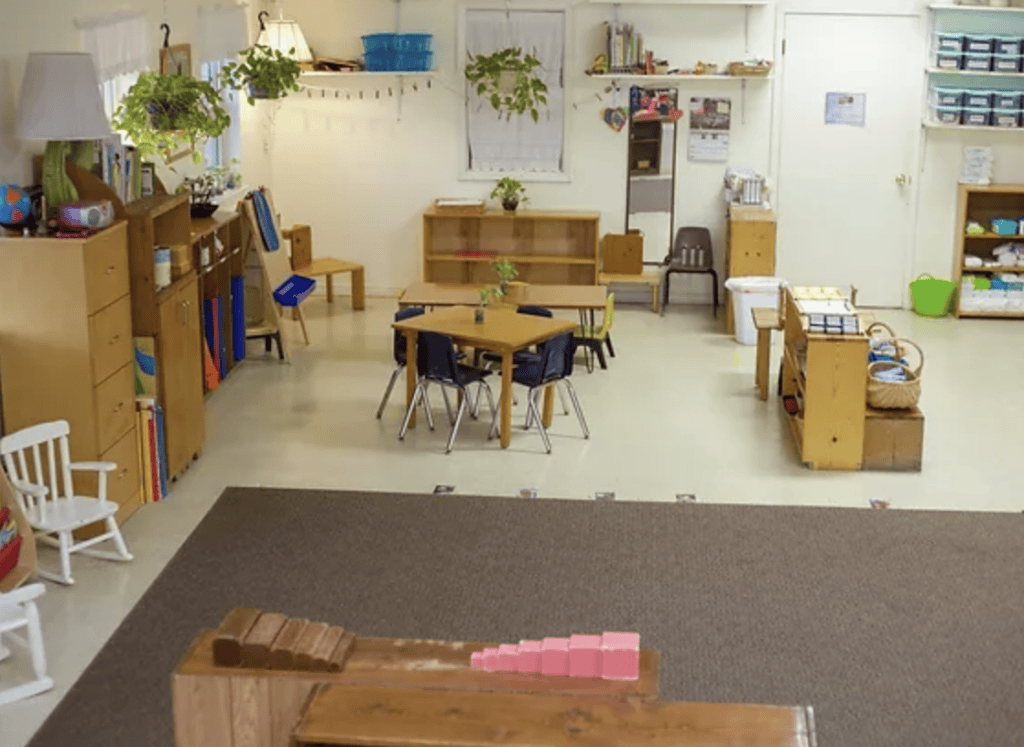
Maria Montessori built her first classrooms around this idea more than a century ago. Her daily “exercises of practical life” had children dressing themselves, dusting tables, learning to handle everyday objects, and setting and clearing the table for lunch.³ None of it was arranged for tidiness. It was arranged so that a child could act without asking permission, and act safely.
Order does a second job here that parents often miss. Montessori described early childhood as a series of “sensitive periods,” stretches of time when a child is intensely drawn to one kind of development, and order is among them.⁴ When everything has a place and stays in it, a child builds a reliable mental map of the room. She knows where the door is. She knows where her teacher usually stands. She is not spending her attention on figuring out the space, so she has attention available when something changes. That is precisely the capacity an emergency asks for.
Real tools, and why we use them
Visitors sometimes pause at the glass. We use real glass pitchers and real ceramic bowls with children as young as eighteen months. We use child-sized knives for cutting bananas and cucumbers. The scissors are real scissors.
The reasoning is not bravado. A plastic cup dropped on the floor bounces and teaches nothing about consequence. A small glass pitcher, carried with two hands across a room, gives immediate and honest feedback about care. Children rise to it, and they almost always rise to it faster than adults expect. Montessori herself described four-year-olds serving and eating a meal in which “not a glass is broken.” She credited that care to something developing within the children themselves, not to the teacher’s control.⁵
What makes this safe is not the object. It is the sequence around the object. A child is shown how to carry the pitcher before she is given one. She practices with it empty. She practices with a little water. Nothing is handed over before the lesson that goes with it. The whole time, a trained adult is watching for the moment when a child is ready, and for the moment when she is not.
Research on children’s play points in the same direction. A 2015 systematic review of risky outdoor play found overall positive effects on children’s health and behavior. Risky play here means climbing, exploring, and play with a real chance of a bump. The authors called for more of these opportunities, not fewer.⁶ A glass pitcher is a much smaller risk than a climbing tree, but the logic is related: graduated, supervised challenge builds capability. That is the hope behind every real tool on our shelves. We want a child who is trusted with care in small things to carry that care into larger ones, like moving carefully near the stove at home.
Practical life is a safety curriculum
To a first-time visitor, the area of the classroom we call practical life looks like housekeeping: pouring, spooning, buttoning frames, sweeping, washing a table, polishing.
It is the most important shelf in the room, and one of the reasons is safety.
A child who has spent months pouring water has hands that know how to control a heavy object. A child who has carried a tray across a room a hundred times has learned to look where she is going and to move around obstacles. A child who can fasten and unfasten her own coat can get herself dressed to go outside quickly. An emergency draws on these physical skills, and they are built on ordinary mornings, months before anyone needs them.
Practical life also teaches the habit that matters most: finishing the sequence. Take the work out, do it, put it back, and the room is as you found it. Researchers have found that children in well-run Montessori preschools score higher on executive function than comparison children.⁷ ⁸ Executive function covers the planning, self-control, and attention that let a child follow a routine. Those studies measured the Montessori program as a whole, not practical life on its own, so we would not claim more than that. But practical life is where a great deal of the day’s sequencing happens.
The drill itself
We do practice fire drills. Louisiana’s licensing rules for early learning centers require documented practice drills that include every child.⁹ The national fire code that applies to child-care settings calls for egress drills every month.¹⁰ Repetition is built into the year. What matters is how it is done.
With young children, the aim is not urgency. It is familiarity. National guidance from school psychologists and school resource officers was written for lockdown drills, but it rests on the same principle. It asks that drills be calm and appropriate to a child’s developmental level, because children read danger from the adults around them.¹¹ A drill that frightens a three-year-old works against its own purpose. So the route is walked calmly until it is simply a thing the class knows how to do: line up, hold the rope or a friend’s hand, walk this way, stop here, wait with your teacher.
Repetition does the work that instruction cannot. A child may walk a route a dozen times with no fear attached to it. By then the route belongs to him or her. The teacher’s voice is familiar, their place in the line is familiar, and there is nothing new to process at the moment when processing is hardest. Remember the frightened child who hides. A calm, familiar routine is meant to give her something better to do.
That is the whole principle of the prepared classroom, applied to an emergency: remove what is unfamiliar in advance, so that competence is already in place when it is needed.
What to look for on a school tour
If safety is on your mind as you visit schools, and it should be, here is what to watch for beyond the locked door and the sign-in sheet.
- Can the children reach what they need? Or does every small task require an adult?
- Are there real tools? Glass, ceramic, and metal, in child-sized proportions.
- Is there a visible place for everything? Ask a child where something goes and see whether she knows.
- How does a spill get handled? The response tells you a great deal about the room.
- Ask how often drills are practiced, and how the youngest children are taught the routine.
We would be glad to walk you through it ourselves. Request a tour and come during a working morning, when the classroom is doing what it actually does.
Sources
- FireRescue1, “NFPA announces Fire Prevention Week 2026 theme: Safe charging.” https://www.firerescue1.com/fire-prevention-week/nfpa-announces-fire-prevention-week-2026-theme-safe-charging
- Nationwide Children’s Hospital, Center for Injury Research and Policy, “Fire Safety for Children.” https://www.nationwidechildrens.org/research/areas-of-research/center-for-injury-research-and-policy/injury-topics/home-safety/fire-safety-for-children
- Montessori, M. (1912). The Montessori Method (A. E. George, Trans.), ch. XX, “Sequence of Exercises.” https://digital.library.upenn.edu/women/montessori/method/method-XX.html
- Association Montessori Internationale, “Sensitive Periods” (glossary). https://archives.montessori-ami.org/help/glossary/sensitive-periods
- Montessori, M. (1912). The Montessori Method, ch. XXII. https://www.gutenberg.org/files/39863/39863-h/39863-h.htm
- Brussoni, M., et al. (2015). What is the relationship between risky outdoor play and health in children? A systematic review. International Journal of Environmental Research and Public Health, 12(6), 6423–6454. https://www.ncbi.nlm.nih.gov/pmc/articles/PMC4483710/
- Lillard, A., & Else-Quest, N. (2006). Evaluating Montessori education. Science, 313(5795), 1893–1894. https://pubmed.ncbi.nlm.nih.gov/17008512/
- Lillard, A. S., et al. (2017). Montessori preschool elevates and equalizes child outcomes: A longitudinal study. Frontiers in Psychology, 8, 1783. https://pmc.ncbi.nlm.nih.gov/articles/PMC5670361
- Louisiana Administrative Code, Title 28, Part CLXI (Bulletin 137), §1921, Emergency Preparedness and Evacuation Planning. https://regulations.justia.com/states/louisiana/title-28/part-clxi/chapter-19/section-clxi-1921
- National Fire Protection Association, NFPA 101: Life Safety Code, chapters 16–17 (day-care occupancies).
- NASP, NASRO, and Safe and Sound Schools (2026). Best Practice Guidance for School Safety and Lockdown Drills. https://makeourschoolssafe.org/wp-content/uploads/2026/05/Safety-Drills-Guide-2026-web.pdf
Kinder Haus Montessori has served children ages one through six in Metairie since 1984, welcoming families from Metairie, Kenner, New Orleans, River Ridge, and Lakeview.
Educational content only. Research is attributed to its source and is not a guarantee of outcomes for any individual child.